Behind the Build
How We Built Creative Director AI for the Google Agent Hackathon

For independent artists and solo creators, turning a song into a broadcast-ready music video is a major production bottleneck. The creative vision is there, but executing it requires days of analyzing audio stems, writing scene-by-scene storyboards, generating clips across disconnected web tools, and manually editing everything to the beat.
While models like Google Veo and Imagen 3 generate stunning cinematic visuals, tying them into a coherent narrative usually requires constant human micromanagement.
For the Google Hackathon, we set out to build a zero-touch pipeline for Track 1 (The Taskmaster): Creative Director AI—an autonomous, event-driven video director that listens directly to raw music waveforms and coordinates the entire production workflow end-to-end.
What It Does
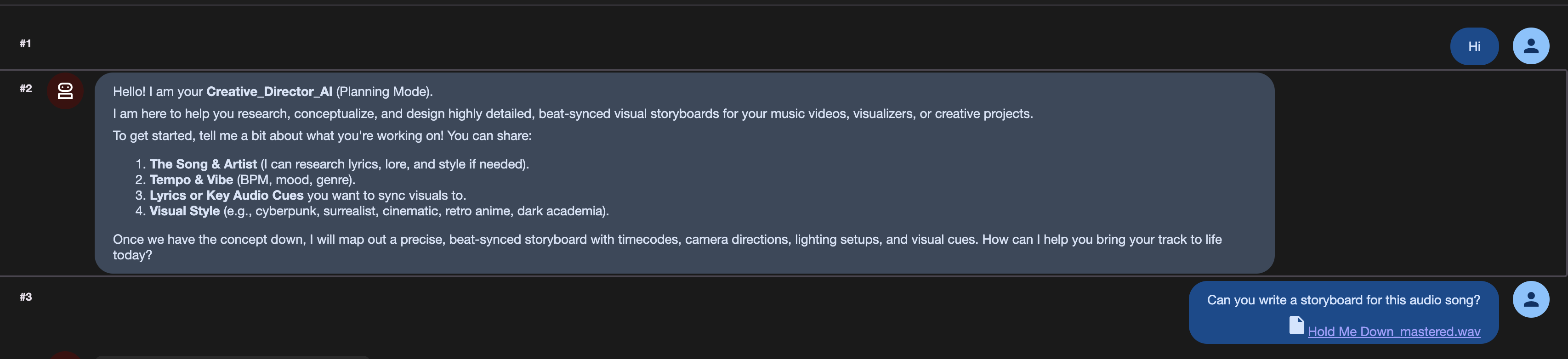
Creative Director AI transforms raw audio tracks into fully assembled, beat-synced music videos with verifiable provenance.
Multimodal Audio Decomposition: Passes raw audio files directly into Gemini to analyze tempo (BPM), dynamic build-ups, structural markers (verse, chorus, bridge), and emotional tone without relying on external transcription tools.
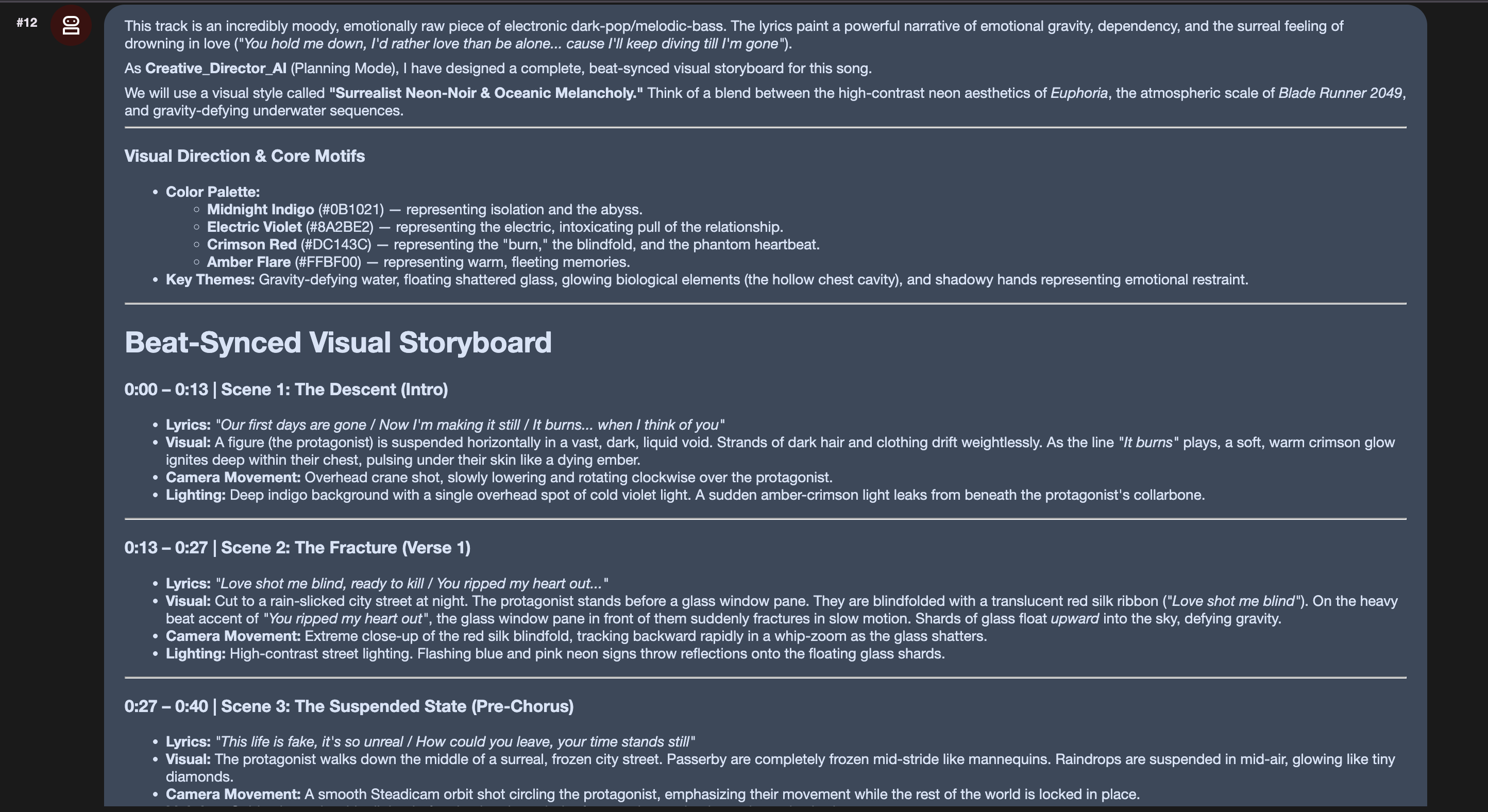
Cinematic Storyboarding: Translates the song's energy into timestamped visual scenes with detailed shot directions, camera motions, and color palettes.
Autonomous Cut Generation: Dispatches structured tool calls to Google Veo and Imagen 3 to generate high-fidelity scene cuts.
Timeline Assembly & C2PA Provenance: Stitches rendered cuts to the musical timeline and seals the output file with verifiable C2PA provenance metadata to guarantee content authenticity.
Technical Implementation
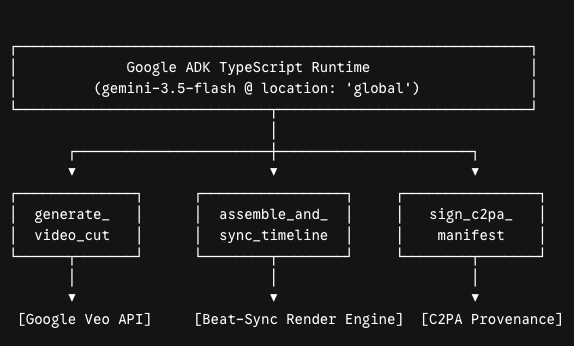
Instead of building a simple chatbot wrapper, we implemented an autonomous Taskmaster agent using the Google Agent Development Kit (ADK) in TypeScript.
- Strict Typed Function Calling with Zod
To ensure the orchestrator wouldn't hallucinate fake render URLs, we bound strict Zod schemas to our custom production tools:generate_video_cut,assemble_and_sync_timeline, andsign_c2pa_manifest.
const generateVideoCutTool = new FunctionTool({
  name: 'generate_video_cut',
  description: 'Renders a cinematic video cut using Google Veo for a specific timestamp.',
  parameters: z.object({
    scene_index: z.number().describe('Sequence number of the scene'),
    timestamp_start: z.string().describe('Start timestamp (e.g. 00:00)'),
    timestamp_end: z.string().describe('End timestamp (e.g. 00:15)'),
    duration_seconds: z.number().describe('Duration in seconds'),
    visual_prompt: z.string().describe('Detailed prompt with lighting and subject action'),
    camera_movement: z.string().describe('Camera motion: slow pan, dolly in, aerial'),
  }),
  execute: async ({ scene_index, timestamp_start, timestamp_end, visual_prompt }) => {
    return {
      status: 'rendered',
      scene_index,
      timecode: `${timestamp_start} - ${timestamp_end}`,
      clip_url: `https://storage.googleapis.com/creative-pixels-renders/cut_${scene_index}.mp4`,
    };
  },
});
Multi-Agent Delegation
The rootCreative_Director_AIagent focuses purely on directing and timeline pacing. If a user references external visual lore or artist history, the director delegates research to dedicated sub-agents (search_specialistandurl_specialist) via ADK'sAgentTool.Serverless Deployment on Vertex AI
We deployed the compiled TypeScript agent directly to Vertex AI Reasoning Engines. This managed runtime handles serverless orchestration and provides Server-Sent Event (SSE) query streaming back to our frontend interface.
Key Takeaways
Audio-Native Intelligence Wins: Ingesting raw audio waveforms directly into Gemini preserves musical nuances, tempo shifts, and emotional dynamics far better than text transcripts.
Strict Schemas Over Open Chat: Agentic pipelines require strict tool validation boundaries to maintain deterministic execution across multi-step generation workflows.
Decoupled Architecture: Separating generative video directing (Google ADK) from on-chain identity and broadcast hosting (Pinata ERC-8004 Digital Twins) created a modular, production-ready stack.
Whats Next
Visual Critic Sub-Agent: Introducing an automated Judge agent into a LoopAgent flow to critique and approve visual continuity before final rendering.
Live Studio Integration: Streaming the Vertex AI Reasoning Engine execution logs directly into our live Creative Pixels studio canvas.
Automated Broadcasts: Connecting completed C2PA video masters to on-chain digital twins for autonomous live streaming and community rewards.
Want to try it out? Take our new Creative AI Director for a spin inside the Creative Pixels video workstation—fresh out of the #AllThingsAgentic hackathon!